Walking around Tate Modern’s Gerhard Richter retrospective a few years ago, I was struck first and foremost by the sheer variety of the work on show. Most of modern art’s great practitioners have their ‘one big idea’: they find a style, a voice, a genre, then spend the rest of their careers mining it for all it’s worth. Richter is different.
One of the curiosities – and pleasures – of his work is that it feels like a fairly complete survey of the last half-century of painting itself, so wide-ranging are his works in their choice of tone and subject matter. Taken as a whole, his work causes one to conclude that Richter simply loves paint itself, but when it comes to ‘style’, he’ll try his hand at anything.
That said, his early work is characterised by what you could call an identifiable ‘style’: this blurred photo-realist approach simultaneously demonstrates what a fiercely accomplished painter Richter is technically, while also asking provocative questions about painting’s relationship to photography; about the gap between perception and reality; about the differences between what can, and can not, be seen.

These paintings are both photo-realistic and highly impressionistic. They show and hide in equal measure. Fascinating to engage with, their explicit realism sets up one relationship with the viewer, while their soft, equivocal and opaque execution delivers something altogether different.
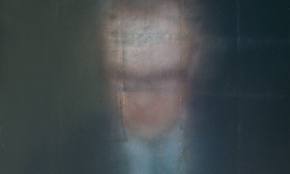
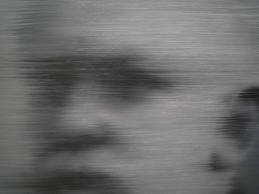
You could speculate that it was somehow fitting for such an important post-war German painter to evolve a style that quietly and insistently spoke of a resistance to seeing things, of an unwillingness to apprehend reality and memory too directly. Perhaps, Richter represents a particular cultural expression of a German consciousness, struggling to confront head-on the appalling realities of 20th century history. What artist could look, directly, at the Holocaust, at Auschwitz, and not recoil? What artist in these circumstances would not wish to see the world through a blurred and opaque filter?
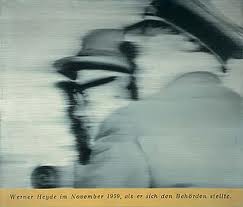
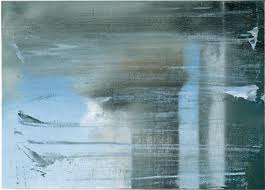
Richter’s vastly different later paintings constitute neither revolution nor evolution: they are simply different. Richter has not moved away from his early style: as varied as his later works are, they have joined – not replaced – the blurred-photo pictures we have already seen. Indeed, one of his most affecting paintings of the last decade is a brilliant and moving variation on this style: September, a haunting replication in paint of the atrocity of 9/11, New York’s twin towers set in dark and crumbling shadow. Horizontal slashes, cuts in the paint, replace and symbolise the eviscerating violence of aeroplanes turned, by the aberration of religious fanaticism, from vehicles into missiles.
These paintings would be enough on their own for a very enjoyable show but Richter’s artistic drive, restless and promiscuous, wants more than that. And so, his approach veers from authentically photo-realist (non-blurred) paintings to extraordinary abstracts that seem to come from some completely other part of the painter’s psyche. Brash, intense and luridly colourful, these images adorned the exhibition with an almost supernatural exuberance.
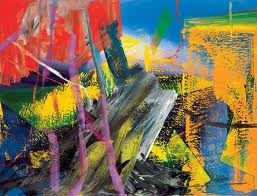
Abstract paintings, by their nature, encourage a reflective mood: shorn of figurative association, the viewer’s mind is pulled into a more focused relationship with the essentials of colour and line. Musical metaphors come to mind: if Mark Rothko’s abstract paintings are a soft cloud of cello chords, Richter’s are a bracing blast of trumpets, a glacial choir in the middle distance, high-volume eruptions turned up to eleven.
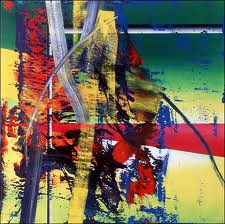
These paintings could not have been more different to the other works in this show. If we were churlish we might almost suspect something untoward in Richter’s restless insistence on not sticking to one style, a single approach. It makes us wonder: what is Richter’s big idea, his unifying theme? Or is it just the case that, unlike most artists, he simply doesn’t have one – and doesn’t need one, either?
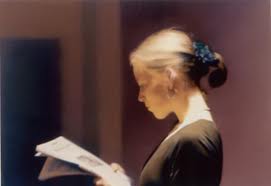
Perhaps. Or maybe, the unifying element in all the works in this retrospective was the simple fact that they were all, each and every one of them, paintings – coloured-oil images committed to canvas by the same hand and in the same medium.
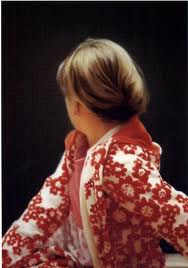
Maybe, for Richter, the only consistency he requires is the act of painting: the careful application of paint to brush and of brush to canvas. Perhaps that is the only conceptual cogency he will ever need. In that case, with this important and fascinating painter of the modern world, the paint really is the point.
 Dom Dawes Communications
Leave a comment